How GSG inspects cards

The same card, viewed from more than one angle.

A straight-on image records the card's design and overall condition. Measured guides and directional rake lighting add information that ordinary inspection can flatten or hide. Each card submitted for grading is imaged ten times so its front, back, and response to several lighting directions can be compared. These examples are real captures from GSG-certified cards.

Measured alignment

Centering is measured in both directions.

Horizontal and vertical guides identify the same uninterrupted printed boundary on all four sides. Comparing the remaining space on opposite sides produces left/right and top/bottom border splits without relying on asymmetric labels or decorative extensions.

Subtle horizontal imbalance

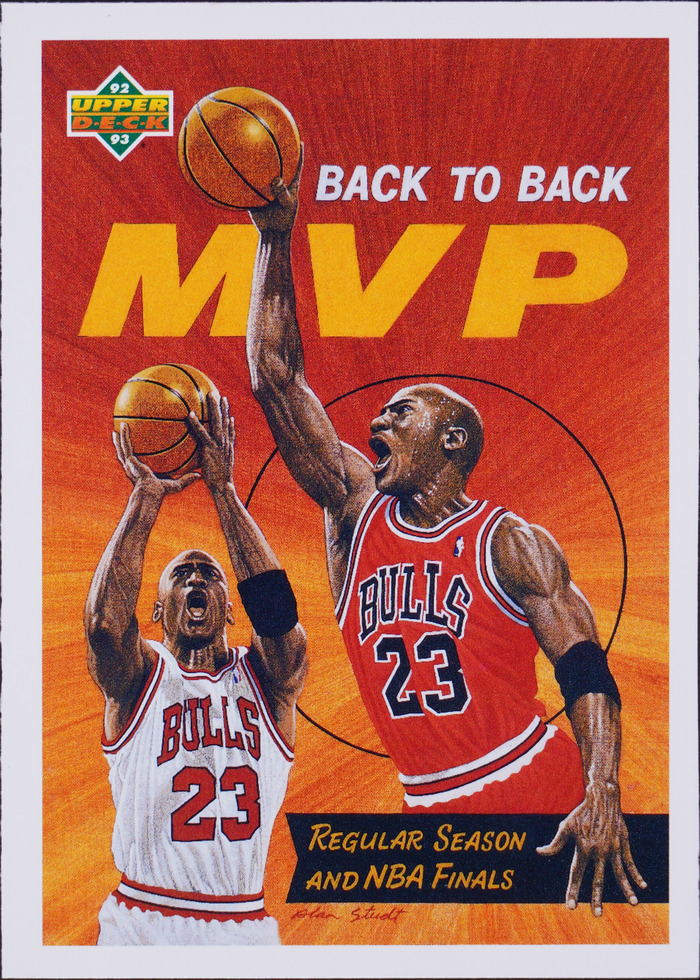
Michael Jordan

Cert 00001131
Michael Jordan card with guides aligned to the uninterrupted red field
Front left / right56.6 / 43.4 Front top / bottom52.6 / 47.4 ReferenceRed field

Nearly balanced borders

Roger Maris

Cert 00001039
Roger Maris card with guides aligned to the uninterrupted photograph boundary
Front left / right48.2 / 51.8 Front top / bottom45.9 / 54.1 ReferencePhoto edge
Vertical print boundaries Horizontal print boundaries
Directional edge inspection

Low-angle light separates relief from print.

Chips, impressions, raised fibers, and rough cuts can blend into a printed border under overhead light. Rake views reveal the physical profile of the same edge.

Distributed recesses

Luka Doncic

Cert 00001137
Overhead
Luka Doncic front-right edge under overhead lighting
Side rake
The same Luka Doncic edge under low-angle side rake lighting

Repeated cut-line recesses become distinct when light travels across the edge.

Cut-edge fraying

Shohei Ohtani

Cert 00001075
Overhead
Shohei Ohtani back-top edge under overhead lighting
Rake 2
The same Shohei Ohtani edge under low-angle rake lighting

Fibers and shallow fraying separate from the printed border under directional light.

Localized edge relief

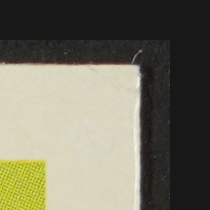
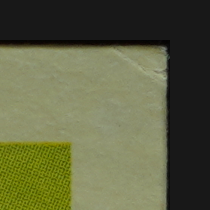
Michael Jordan

Cert 00001087
Overhead
Michael Jordan back-top edge under overhead lighting
Rake 2
The same Michael Jordan edge under low-angle rake lighting

Small raised fibers cast a highlight that is understated in the straight-on view.

Corner inspection

A point can look intact and still be bent.

Directional light can expose a folded plane, lifted point, or inward crease even when the overhead silhouette appears complete.

Triangular corner fold

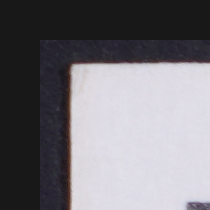
Magic Johnson

Cert 00001072
Overhead
Magic Johnson front top-left corner under overhead lighting
Side rake
The same Magic Johnson corner with a diagonal fold visible under side rake lighting

The outline looks nearly intact overhead, while side rake traces the folded plane.

Inward retained-point crease

Wayne Gretzky

Cert 00001130
Overhead
Wayne Gretzky back bottom-left corner under overhead lighting
Rake 1
The same Wayne Gretzky corner with an inward crease visible under rake lighting

The point remains present, but moving the light exposes a short inward crease.

Surface inspection

A long scratch can disappear into the print.

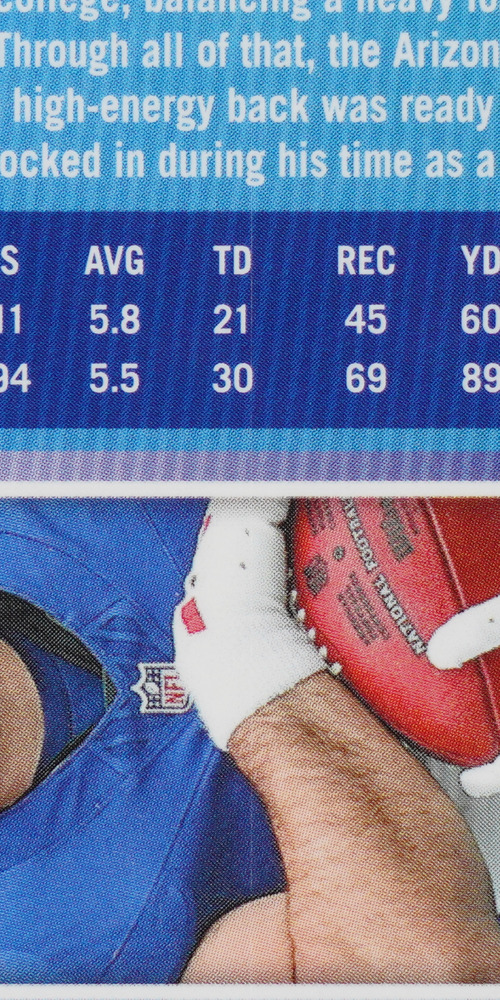
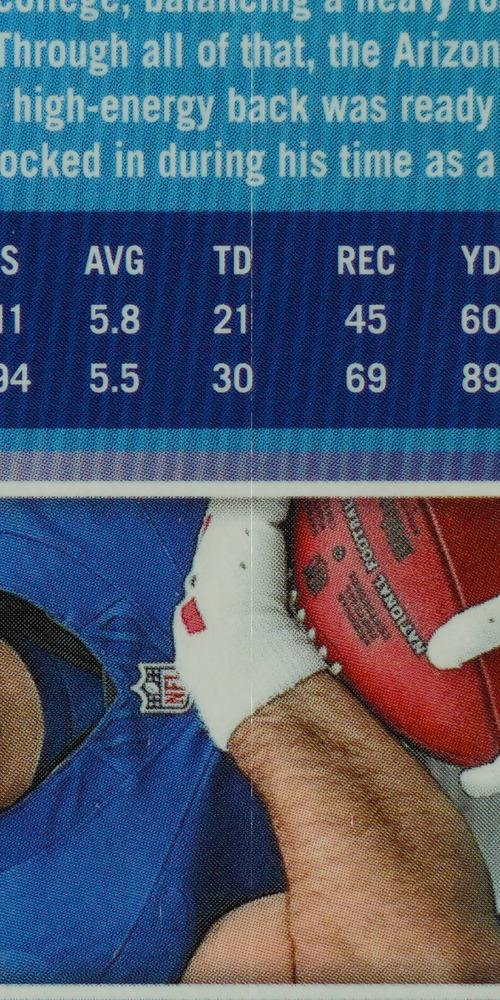
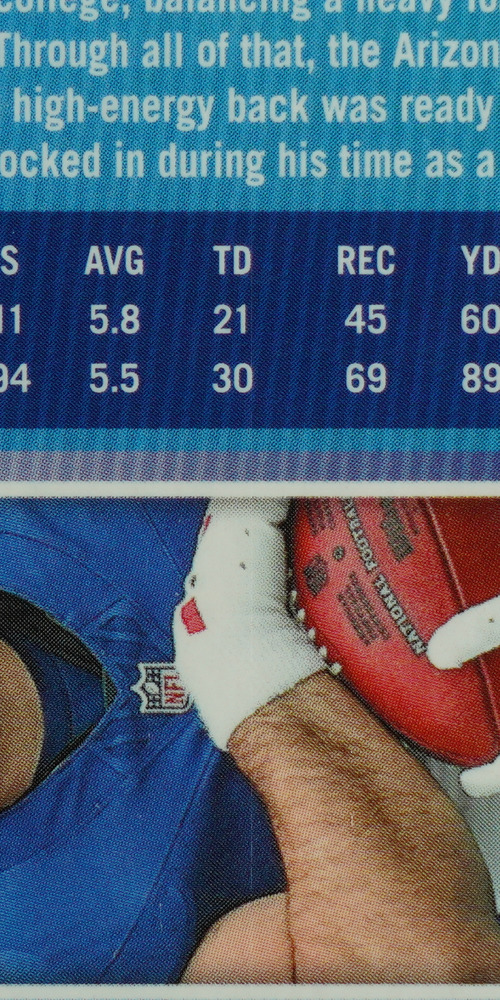
This Cam Skattebo back has a continuous vertical scratch. It is difficult to follow in the overhead capture, then becomes a bright line when the first rake crosses the surface. The opposite rake shows it only faintly because that light travels at a less revealing angle.

Cross-view surface scratch

Cam Skattebo

Cert 00001089
Overhead
Cam Skattebo back surface under overhead lighting with a faint vertical scratch
Rake 1
The same Cam Skattebo surface with the long scratch illuminated by rake lighting
Opposite rake
The same Cam Skattebo surface with the scratch only faintly visible from the opposite rake direction

Not every light direction reveals every defect equally. Comparing aligned overhead and rake views helps distinguish physical relief from printed lines or image texture.